 |
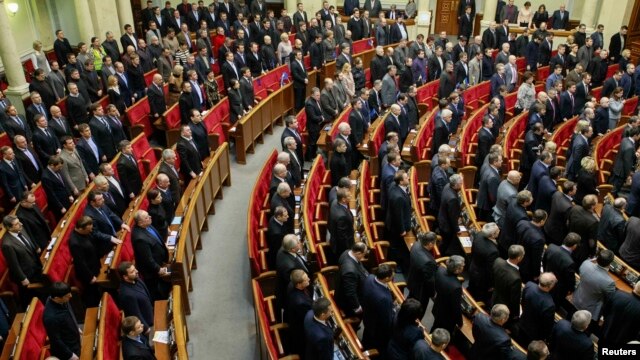
| MPs of Ukrainian Parliament, commemorating the victims of the clashes. Beginning of the session (Image: Radio Svoboda) |
After four rounds of negotiations held between Ukrainian oppositional
leaders and Yanukovich and amid deepening political crisis in the country and
confrontations between the protesters and security forces and seizing of power
by the revolutionaries in several regions of Ukraine, Ukrainian Parliament have
gathered for the urgent session on Tuesday, 28 January. This parliamentary
session was expected to be a decisive one, as parliamentarians had to discuss
the current situation in the country in order to find the solution. In addition
to that there were fears about voting for imposing state of emergency in
Ukraine.
Parliamentary session was attended by many journalists and tens of
diplomats and representatives of the Western countries, looking closely the
situation in Ukraine and urging the sides to find the solution through
negotiations.
The main achievement of the Tuesday’s Parliamentary session was
cancelling of the scandalous dictatorial laws, approved by President on 16
January and restricting civil and personal rights and freedoms of Ukrainians
and contradicting with the Constitution of Ukraine. Imposing of these laws
sparked the wave of criticism within the society and among the experts and
politicians and sparked violent clashes on Grushevsky Street, located close to
the governmental district. The clashes led to the deaths of 5 protesters and
have left dozens of wounded.
The overwhelming majority of the parliamentarians have voted in favor of
cancelling of these dictatorial laws on Tuesday, though several laws have been
left in power, but it was decided that they will be amended. This step was a
big victory for the people of Ukraine and the oppositional leaders as well.
In addition to that there have been talks regarding the amendments to
the Constitution and returning to the 2004 Constitution, which limited the
powers of President and declared parliamentary-presidential republic in
Ukraine. The decision was taken, that special Constitutional Committee will be
formed and work on the amendments of the Constitution, though the consultations
and discussions of the issue will continue.
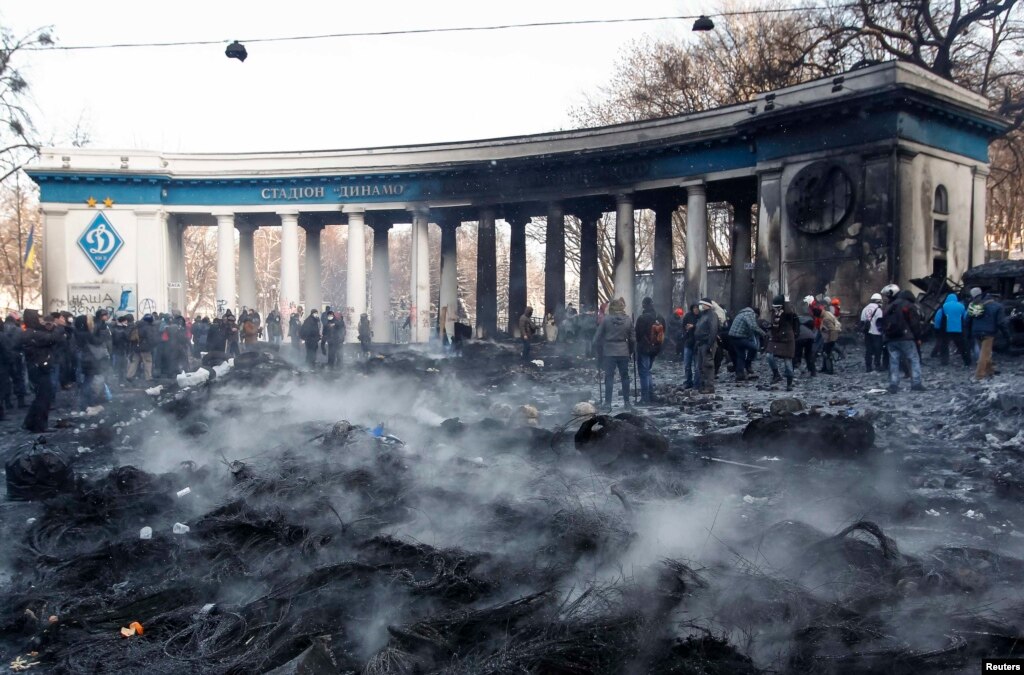 |
| Dynamo Stadium in Grushevsky Street, the site of confrontations between protesters and security forces (Image: Radio Svoboda) |
As for one of the most important demands of Maidan and oppositional
leaders expressed during the talks with the authorities, which is imposing of
the amnesty law and release of all the political detainees and detained
activists and protesters, parliamentarians have decided to continue discussion
of the details on Wednesday, during the next parliamentary session.
Pro-government parliamentarians and representatives of Yanukovich’s team state
that amnesty law should be imposed only after protesters will leave the
governmental and administrative buildings and the streets of Kyiv and others
cities and stop their protests.
Meanwhile Ukrainian Prime Minister Mykola Azarov has submitted his
resignation request to Victor Yanukovich on Tuesday, declaring this step is
considered being the best due to the difficult circumstances and situation in
the country. All the cabinet of Ministers has resigned together with Mr.
Azarov. Yanukovich in his turn has signed the decree about the Cabinet’s and
Azarov’s resignation, thus, another demand of Maidan seems to be also met. But
Azarov’s Cabinet, headed temporally by his Vice-Prime Minister Sergiy Arbuzov,
will remain in charge during the next weeks, until the new government will be
appointed. There are currently many speculations regarding the person to head
the government.
We would remind, that oppositional leader Arseny Yatsenyuk was offered
the position of Prime Minister by Yanukovich during the third and fourth rounds
of the talks, while Vitaly Klichko was promised the position of Vice Prime
Minister in Humanitarian issues, but both of them have refused the positions.
Meanwhile protesters remain in Kyiv downtown, In Independence Square,
Grushevsky Street and in the previously seized administrative buildings, while
uprising spread to more and more regions of the country, as people take the
regional offices and impose the people’s rule.

No comments:
Post a Comment