 |
| Gershon Baskin, prominent Israeli peace activist |
In the light of the latets events in
Gaza, which are terrible, I'd like to share here this article.
This article is published in Israeli
news source Haaretz.
It's the ideas and statements if
Gershon Baskin, Israeli peace activist and prominent figure, who is also the
founder of Israel/Palestine Center for Research and Information and is
advocating for peace in the Middle East.
The original of the article, written
by Nir Hasson, is published here.
Israeli peace activist: Hamas leader Jabari killed amid talks on long-term truce
Gershon Baskin, who helped mediate
between Israel and Hamas in the deal to release Gilad Shalit, says Israel made
a mistake that will cost the lives of 'innocent people on both sides.'
By Nir Hasson | Nov.15, 2012
Hours before Hamas strongman Ahmed
Jabari was assassinated, he received the draft of a permanent truce agreement
with Israel, which included mechanisms for maintaining the cease-fire in the
case of a flare-up between Israel and the factions in the Gaza Strip. This,
according to Israeli peace activist Gershon Baskin, who helped mediate between
Israel and Hamas in the deal to release Gilad Shalit and has since then maintained
a relationship with Hamas leaders.
Baskin
told Haaretz on Thursday that senior officials in Israel knew about his
contacts with Hamas and Egyptian intelligence aimed at formulating the
permanent truce, but nevertheless approved the assassination.
“I think that they have made a
strategic mistake," Baskin said, an error "which will cost the lives
of quite a number of innocent people on both sides."
 |
| Israeli strikes against Gaza |
"This blood could have been
spared. Those who made the decision must be judged by the voters, but to my regret
they will get more votes because of this,” he added.
Baskin made Jabari’s acquaintance
when he served as a mediator between David Meidin, Israel’s representative to
the Shalit negotiations, and Jabari. “Jabari was the all-powerful man in
charge. He always received the messages via a third party, Razi Hamad of Hamas,
who called him Mister J.”
For months, Baskin sent daily
messages in advance of the formulation of the deal. He kept the channel of
communication with Gaza open even after the Shalit deal was completed.
According to Baskin, during the past
two years Jabari internalized the realization that the rounds of hostilities
with Israel were beneficial neither to Hamas nor to the inhabitants of the Gaza
Strip and only caused suffering, and several times he acted to prevent firing
by Hamas into Israel.
He said that even when Hamas was
pulled into participating in the launching of rockets, its rockets would always
land in open spaces. “And that was intentional,” clarified Baskin.
In recent months Baskin was
continuously in touch with Hamas officials and with Egyptian intelligence as
well as with officials in Israel, whose names he refused to divulge. A few
months ago Baskin showed Defense Minister Ehud Barak a draft of the agreement
and on the basis of that draft an inter-ministry committee on the issue was
established. The agreement was to have constituted a basis for a permanent
truce between Israel and Hamas, which would prevent the repeated rounds of
shooting.
“In Israel,” Baskin said, “they
decided not to decide, and in recent months I took the initiative to push it
again.” In recent weeks he renewed contact with Hamas and with Egypt and just
this week he was in Egypt and met with top people in the intelligence system
and with a Hamas representative. He says he formed the impression that the
pressure the Egyptians applied to the Palestinians to stop shooting was serious
and sincere.
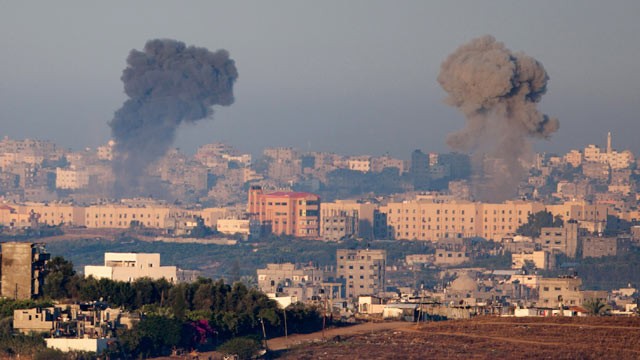 |
| Israel strikes the civilian Gaza nieghbourhoods |
“He was in line to die, not an angel
and not a righteous man of peace,” Baskin said of Jabari and of his feelings in
the wake of the killing, “but his assassination also killed the possibility of
achieving a truce and also the Egyptian mediators’ ability to function. After
the assassination I spoke to the people in Israel angrily and they said to me:
We’ve heard you and we are calling to ask if you have heard anything form the
Egyptians or from Gaza.”
Since the assassination, Baskin has
been in touch with the Egyptians but not with the Palestinians. According to
him, the Egyptians are very cool-headed. They said it is necessary to let the
fresh blood calm down. "The Egyptian intelligence people are doing what
they are doing with the permission and authorization of the regime and
apparently they very much believe in this work,” he says.
“I am mainly sad. This is sad for
me. I am seeing people getting killed and that is what is making me sad. I tell
myself that with every person who is killed we are engendering the next
generation of haters and terrorists,” adds Baskin.

No comments:
Post a Comment