 |
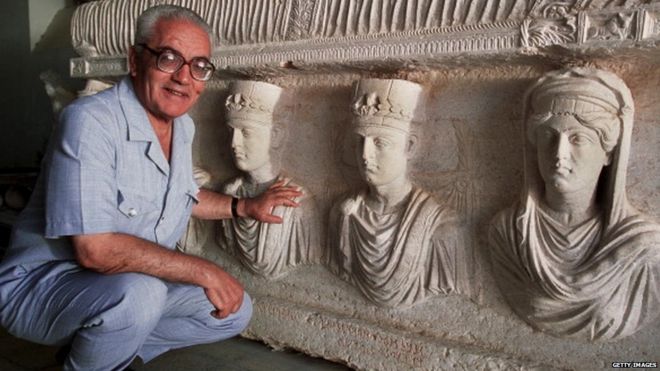
| Khaled Asaad, Head of Antiquities of the city of Palmyra and prominent archeology and history scholar (Image: Getty Images) |
Islamic State
militants have executed prominent Syrian antiquities scholar and archeologist
Khaled Asaad, according to the Syrian authorities and account of Mr. Khaled’s
relatives. His body was displayed by the jihadists in the middle of Palmyra, at
the gates to the ancient historic site.
Khaled Asaad,
82, was one of the most prominent archeologists of Syria and Middles East and
worked as a head of antiquities of Palmyra Museum for over 50 years. Shortly
before the city of Palmyra was seized by ISIS militants in May this year,
Khaled Asaad participated in an operation of evacuation of numerous
archeological artifacts and museums’ treasures, and it meant he’d certainly
face arrest, as he stayed in the city.
Khaled Asaad was
captured by ISIS and held in detention for over one month. According to the
Syrian and Palmyra based human rights activists, he was terribly tortured and
interrogated by IISI, but he refused to cooperate and to reveal where the
valuable artifacts were hidden and saved. He was murdered by the ISIS fighters
for that, and his mutilated body was hung from one of the ancient columns of
Palmyra old city. A board placed in front of his body said that he was killed
because of his loyalty to Syrian President Bashar Al-Assad and for managing
Palmyra’s “collection of idols”.
According to the
UK-based Syrian Observatory for Human Rights and Syrian news agency Sana Khaled
Asaad was executed in front of dozens of Palmyra residents on Tuesday, in front
of the square outside of Palmyra Museum.
The brutal
killing of Khaled Asaad is the latest shocking atrocity committed recently by
ISIS which controls a third of Syria and vast territories of the neighboring
Iraq.
 |
| Antique complex in the city of Palmyra (Image: International Business Times) |
Maamoun
Abdulkarim, Syrian Minister of Antiquities, confirmed that Asaad’s family
informed him about that a prominent scholar was killed in Palmyra on Tuesday,
18 August. Syrian Minister of Antiquities strongly condemned this terrible act
of violence committed by ISIS. Khaled Asaad’s brutal execution shocked the
entire scientific and archeological world, as terrible death of Khaled Asaad is
a terrible loss for the scientific world and he was “irreplaceable”.
Ultra-radical
Islamic State fighters seized the city of Palmyra in May 2015 and executed
dozens of local residents in the first days, according to the reports and
accounts of human rights’ groups and organizations. Several historical
buildings of an ancient city of Palmyra and several shrines were reportedly
destroyed by ISIS, although the most famous antique complex was reportedly
safe.
ISIS is known
for their lootings and destruction of numerous historical buildings, shrines,
museums and archeological artifacts, many of them are considered by the
jihadist group being the “idols” and signs of “paganism”. Terrible tortures and
brutal executions, often filmed and then demonstrated widely through internet, are
also significant signs of ISIS as they capture more and more territories.
Arab and
Western, US-led coalition launched a massive military operation against the
forces of ISIS in Syria and Iraq, including massive bombings and aerial strikes
against ISIS targets. Though, despite the military operation ISIS still holds
vast territories in Syria and Iraq, committing terrible atrocities in the
cities, controlled by the jihadist group.

No comments:
Post a Comment