 |
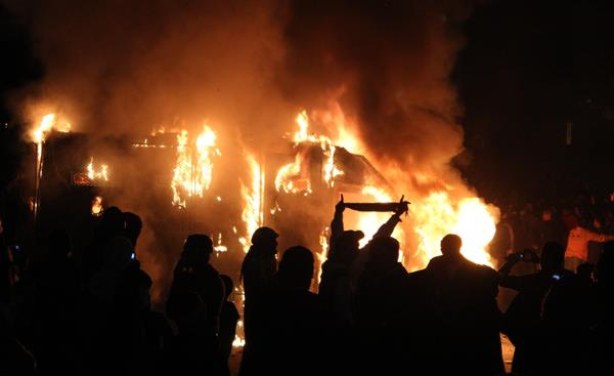
| Port Said protesters |
The protests and violent clashes along with the public act of civil
disobedience continue in Egypt’s Canal city of Port Said.
The huge protests and clashes erupted in the city after the court
announced the verdict for 21 out of 73 defendants in the case of last year’s
Port Said football massacre and sentenced them to death. Angry Port Said
residents have been protesting against injustice and neglecting the problems of
their city and chanted against Muslim Brotherhood and the current President of
Egypt Mohamed Morsy. Police have been using excessive power against the
protesters what cause the death of more than 45 people and left hundreds of
injured.
The protests and the acts of civil disobedience made the situation in
the region extremely tense during the weeks. The protests continue in Port Said
and sparked again after the Court took a decision to transfer the defendants to
another prison. The protests sparked in front of the SCF headquarters on
Sunday, 3 March, and they are continuing till now, ahead of the next stage of
the trial expected to be held on 9 March.
I’d like to share here the article posted here in Ahram Online which highlighted
the current situation in Port Said and also describes the moods in the city.
Egypt's Port Said on edge ahead of controversial court verdict
Decision to transfer Port Said prisoners out of city prompts protesters
to attack local security directorate; syndicates, youth groups organise ahead
of Saturday's Port Said trial verdict
Karim Hafez in Port Said, Thursday 7 Mar 2013
Port Said, one of the most prominent canal cities, has been recently hit
by a wave of violence in ongoing clashes between Egyptian security forces and
protesters; further turmoil is expected ahead of the second Port Said football
court verdict scheduled for 9 March.
The recent decision to transfer the prisoners convicted or facing
charges for their role in the February 2012 Port Said stadium disaster to an
unknown location outside of the city revived unrest in the canal city, as
thousands reportedly have attacked the security directorate since Sunday.
Clashes are still ongoing.
There is no police presence in the city, and army units are spread all
over. In response, citizens have formed popular committees to organise traffic.
"Traffic police have disappeared from the city for the third time
in less than two months, so we decided to form popular committees to organise
traffic in the city’s main streets like El-Thalathiny,"ِ Ahmed Said, owner
of a stationery shop in El-Thalathiny Street, told Ahram Online.
 |
| Protests and clashes in Port Said |
Huge banners cover the city's streets with pictures of slain protesters
that have been killed in the violence after a court verdict issued on 26
January sentenced 21 out of 73 defendants to death for their involvement in the
Port Said football riot.
"Revenge is our duty towards the martyrs," one banner read.
Other signs on Port Said's walls, such as "Injustice leads to
explosion" and "Together we will resist injustice," denounce the
'injustice' the city has been subjected to since the Port Said Stadium disaster
last year.
"The courageous city will forever be resilient," read another
slogan spread around the city.
The city is dominated by growing feelings of "injustice" and
the urge to take "revenge." Most Port Said residents believe the
police have been using extreme violence against protesters, following the 26
January court verdict that led to violent clashes and resulted in more than 40
people killed, mostly civilians, and during the city's most recent protests.
"The decision [to relocate the prisoners] was taken without the
knowledge of the local authorities; the families of the prisoners have the
right to know the whereabouts of their children. The injustice against Port
Said must come to an end," said renowned leftist politician and former MP
El-Badry Farghaly.
The ‘Martyrs Square,’ located in central Port Said, that was once
erected to honour the fallen heroes and 'martyrs' during the Tripartite
Aggression in 1956, is now a battle zone with parts of the governorate building
and the security directorate destroyed after being set ablaze.
"Protests are not as intense now as the past days. The police have
been using live ammunition against the protesters and extreme force since
Sunday. On Monday, the police even shot at a nearby shop and broken glass fell
on protesters," Mahmoud El-Makhzangi, activist and founding member of the
Port Said youth bloc, told Ahram Online.
"A 17-year-old was killed yesterday by Egyptian riot police after
the police threw a ceramic bloc from the roof of the governorate at the
teenager. At least three others have been killed since Sunday, most of them
youth, and hundreds have been injured," El-Makhzangi explained.
Almost 177 people were injured since 3 March, according to the Ministry
of Health.
Army units are strategically positioned in front of the entrance of the
Port Said governorate, the building adjacent to the security directorate, maintaining
a neutral stance. Occasionally, the army will clear the path for ambulances and
help citizens in distress.
However, reports of the army units clashing with the police have been
recurrent in the past days.
"On Monday night, an army brigadier fired at a police armoured car
in an attempt to push it back away from protesters. This has occurred several
times since the beginning of the clashes," said member of the Ultras Green
Eagles group Mahmoud Abu Zekry.
The Ministry of Defence has denied those reports on several occasions
since the beginning of the clashes on 3 March.
"I am positioned at the Tarh El-Bahr Street right in the vicinity
of the directorate for three weeks now, and this has never happened. We are
cooperating with the Ministry of Interior to keep the situation under
control," army captain Ahmed Goweily told Ahram Online.
Clashes remain ongoing in front of the Port Said security directorate
with different youth groups, including Egypt's Ultras Ahlawy groups, calling
for a sit-ins and protests on 9 March.
'Civil disobedience' and mass mobilisation
There are talks on civil disobedience all over the city among Port Said
residents. A famous hotel situated in what was once a touristic hotspot
"Al Noures" has covered its entrances with black ribbons as a sign of
mourning and in "solidarity with the civil disobedience."
"The black ribbons is to protest the death of our children, and the
injustice the city is subjected to, I refuse to turn on music or any signs of
joy as solidarity with the civil disobedience," Samir Gouda, executive
manager at the Nores Hotel, told Ahram Online.
Calls for civil disobedience have been launched as a reaction to the
death of almost 43 protesters in front of the Port Said prison following the
controversial verdict.
Schools all over the city are completely closed; students and teachers
have decided not to return despite the governor’s decision to continue classes.
"We as students decided not to resume classes in protest of the
death of our colleague Ahmed Samy, a high school student. Schools have been
halted until this day," said Ahmed Mohsen, student activist and member of
the Revolutionary Socialists student movement in Port Said.
16-year-old Ahmed Samy was shot dead in front of the Port Said prison on
26 January.
Teachers, represented in the Port Said Teachers Coalition, have also
supported the move by deciding to go on strike.
"The step had to be taken, our students are our children, their
safety is our priority, and we will not resume teaching until the safety of our
students is ensured," said the head of the Teachers Coalition Mohamed
Zakarey.
Other syndicates have also taken solidarity steps to support the ‘civil
disobedience' campaign that began on 17 February.
"The Doctors Syndicate is organising to ensure that those injured
from the clashes are not denied access to hospitals. We support any calls of
civil disobedience, however, we did not refrain from working due to the vital
nature of our work," Ahmed Attia, member of the Doctors Syndicate in Port
Said, told Ahram Online.
The investment zone in Port Said, home of over 50 factories and almost
40,000 workers, remains fully operational despite the calls for acts of civil
disobedience.
"Workers of the investment zone have absolutely no job security and
therefore they are at risk of getting fired if they decide to strike,"
explained Mohamed El-Ogiri, labour activist and syndicalist in Port Said.
"There are signs of social protest, mass organisation and general
sympathy towards the cause that is escalating day by day. However, it is not
accurate to describe what's happening as civil disobedience," El-Ogiri
explained.
Most shops, restaurants and cafes that are not
located in the vicinity of the directorate are open for business.

No comments:
Post a Comment