 |
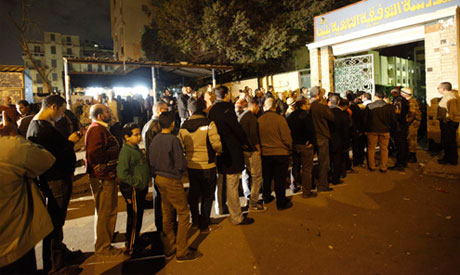
| Egyptians waiting in lines to participate in the Constitutional referendum |
The second stage of the Egyptian historical national referendum on the
draft of the Constitution is expected to be held on Saturday, 22 December 2012.
The first stage which included Cairo, Alexandria, North Sinai, Southern
Sinai, Assiut, Aswan, Sohag, Gharbiya, Daqahliya, Sharqiya has been held on 15
December. Nearly 56,5% of the voters have supported the Constitution while
around 43,5% have voted against it. The voter turnout was nearly 33%.
The next stage of the referendum will include the remaining 17 Egyptian
governorates which will be divided into four groups. The first group includes
Suez Canal cities (Suez, Ismailia, Port Said), the second group for Delta
cities (Damietta, Beheira, Kafr El-Sheikh, Qalioubiya, Menoufiya), the third
group for Upper Egypt (Giza, Fayoum, Beni Suef, Qena, Luxor, Minya) and the
last group will include the border governorates (Marsa Matrouh, New Valley, Red
Sea).
I would like to share here Ahram Online’s article regarding the upcoming
second stage of the Constitutional referendum, the preparation to it and the
information. The original article was published here.
Egypt prepares for a final constitutional vote
Egypt's Islamist-backed constitution will be put to a final stage of
vote on Saturday after a first one that was rife with irregularities and lack
of judicial supervision
Egypt's Islamist-backed constitution will be put to a final stage of
vote on Saturday after a first one that was rife with irregularities and lack
of judicial supervision
An estimated 25.5 million voters – out of a total 51.3 million – in 17
Egyptian governorates are expected to head to the polls on Saturday in the
second phase of the national referendum on the country's first post-uprising
draft constitution.
The governorates can be divided into four groups: three Suez Canal ones
(Port Said, Suez and Ismailia); five Nile Delta ones (Qalioubiya, Menoufiya,
Damietta, Kafr El-Sheikh and Beheira); six Upper Egypt governorates (Giza,
Fayoum, Beni Suef, Minya, Luxor and Qena); and three border ones (Marsa Matruh,
the Red Sea and the New Valley).
According to statistics released by the Supreme Electoral Commission
(SEC), a judicial body officially in charge of supervising the referendum,
there will be 176 main polling stations and 6,724 auxiliary ones operating on
Saturday. Schools, youth centres and courts will house the majority of the
polling stations.
 |
| Egyptian women waiting to participate in the referendum |
Of the 17 governorates voting in Saturday's poll, Giza has the most
number of registered voters, with 4.3 million constituents (representing 17.2
per cent of the total). It is followed by Beheira, with 3.2 million (12.9 per
cent); Minya with 2.7 million; Qalioubiya with 2.6 million and Menoufiya with
2.2 million.
The three border governorates of Marsa Matruh, the Red Sea and the New
Valley together have only half a million registered voters. The three Suez
Canal governorates (Port Said, Suez and Ismailia) include around 1.5 million
voters.
More 'Yes' votes?
Many analysts expect that chances for the vote 'Yes' in this stage could
be much higher than in the first one in which just 57 per cent of registered
voters in the 10 governorates approved the final draft constituents.
Gamal Zahran, an independent political analyst and a former MP for
Qalioubiya Governorate, told Ahram Online that most of the governorates in the
second stage are rural ones, with Muslim Brotherhood maintaining a sizeable
base of support in agricultural governorates such as Beheira, Kafr El-Sheikh,
Damietta, Minya, Beni Suef and Fayoum.
"This is to add to the fact that only three out of the 17
governorates (Port Said, Qalioubiya and Menoufiya) voted overwhelmingly against
Egypt's current Islamist president Mohamed Morsi," said Zahran.
But the fact remains that the two anti-Morsi Nile Delta governorates of
Qalioubiya and Menoufiya are densely populated ones (with as many as 4.8
million registered voters). Menoufiya, the birthplace of Egypt's two former
anti-Brotherhood presidents Anwar El-Sadat and Hosni Mubarak, is expected
overwhelmingly vote against the draft national charter.
 |
| Referendum's ballot |
Qalioubiya voted against most Muslim Brotherhood candidates in this
year's parliamentary elections. Giza, which has the largest number of voters,
was narrowly won by Morsi last June.
Zahran, however, stresses that "we have to be cautious about vote
predictions."
"Presidential elections are different from the vote on the
constitution and this was clear in the first stage," argued Zaharan,
indicating that "Sharqiya, Alexandria and Daqahliya showed a strong 'Yes'
vote on 15 December, although they voted 'No' to president Morsi last
July."
The Muslim Brotherhood claims that it is certain of a 'Yes' turnout in
two Nile Delta governorates (Beheira and Kafr El-Sheikh) that have five million
voters as well as in three Upper Egypt governorates (Minya, Beni Suef and
Fayoum) with 5.6 million voters.
The Muslim Brotherhood and opposition forces have embarked upon
promotion campaigns in most of the 17 governorates over the past few days.
The National Salvation Front (NSF), led by opposition figure and former
IAEA chief, Mohamed El-Baradei, focused on the three Upper Egypt governorates
of Minya, Luxor and Aswan.
NSF's activists Gamila Ismail and Kamal Abbas visited these governorates
to urge citizens, especially the large Coptic community there, to vote 'No' to
the constitution.
Human rights organisations said several radical Islamist groups
intimidated voters in Coptic villages in Qena, Minya and Luxor from voting
against Islamist President Mohamed Morsi during presidential election last
June. NSF believes that if villages were mobilised to turn out in big numbers
on Saturday, millions would likely vote "no” to the constitution.
The NSF have expressed general satisfaction with the results of the
referendum's first phase in which 43 per cent of registered voters voted
against the draft constitution. NSF have also stated their belief that the
first stage of polling was marred by rampant irregularities and fraud.
"The truth is that 66 per cent voted 'No' in the first stage,"
the opposition group stated.
It submitted a memo to the SEC, complaining that the "Muslim
Brotherhood manipulated the first phase of the vote, especially in Alexandria
and in the two Upper Egypt governorates of Assuit and Sohag, in favour of
'Yes'. The lack of judicial supervision gave Brotherhood leaders a free hand to
rig the vote."
The NSF has high hopes that Giza Governorate will turn out a 'No' vote
on Saturday. This governorate voted for NSF member Hamdeen Sabbahi in the first
stage of presidential elections last May.
Several youth revolutionary movements like the April 6 Youth Movement,
the Popular Current and the Constitution Party have stepped up campaigns in
Giza in recent days to push for a 'No' vote.
April 6 has identified that the Giza constituency is comprised mostly of
the younger generation and hope to turn this into a 'No' vote. The group also
stated that their campaigns in rural governorates in the first stage were
fruitful, helping to sway villages to vote against the draft, and that the same
method will be adopted for the second phase.
 |
| Egypt's Constituent Assembly |
Islamists on the other hand were not very excited by the results of the
first phase. Salafist cleric Yasser Borhami, a leading figure in the Salafist
Calling attributed the drop in the 'Yes' vote in the first stage to the
"poor performance of Islamist President Mohamed Morsi and his government."
"This president and his government have made many mistakes in
recent weeks, on top of which is declaring their intentions to raise the price
of some basic commodities," said Borhami.
Buoyed by rich sources of funding, the Muslim Brotherhood and Salafists
have been leading 'Yes' campaigns in several governorates in recent days. They
have distributed millions of posters and placards urging citizens in favour of
the draft constitution.
They have also organised door-to-door campaigns in poor villages in
Upper Egypt and the Nile Delta governorates, with the objective of winning over
poor voters by offering cheap food commodities like oil, sugar and butane gas
in return for a 'Yes' vote.
Lack of supervision
In the meantime, the debate over judicial supervision has heated up. The
Independent Judges' Club warned that “a larger number of judges have decided
not to take part in monitoring the poll next Saturday and that this casts a
cloak of doubt regarding the integrity of this poll."
An estimated 1,400 judges affiliated with the State Council refused to
supervise the second stage. The Club of Administrative Prosecutors also said it
would abstain from observing the polls.
These two developments led the Judges Club, an unofficial body of senior
judges, to warn that "polls next Saturday will be left without any
judicial supervision and with the doors for large-scale rigging will now be
quite open."
Secretary-general of the Higher Electoral Commission Zaghloul Al-Balshi
decided to give up his post on Tuesday. Although Al-Balshi said he had to
resign because of health reasons, analysts argued that "Al-Balshi had to
resign after he had found out that the total lack of judicial supervision would
pose a threat to the integrity of the polls."
"Al-Balshi wanted to resign before he finds himself red-handed with
rigging and fraud charges,” said Zahran. Samir Aboul-Maati, chairman of HEC,
said: “The resignation of Al-Balshi would not affect the second stage of polls
in any way.”
Aboul-Maati also argued that the number of judges available is quite
sufficient to guarantee a fair vote and transparent supervision. "The
number of judges ready for supervising the poll now exceeds 10,000,"
Abul-Maati said.
NSF, however, said "even if it is true, the number of 10,000 judges
is not enough to cover main and polling stations in 17 governorates."
NSF also complained that "in the absence of judicial supervision in
the first stage, the majority of polling stations were merged, and thus
thousands of voters were forced to stand for hours in front of polling
stations.
"There was too many people inside the stations too; there have been
reports of thousands of ballot boxes – especially in rural areas – being
stuffed in the resulting chaos," said NSF, are expected to be much worse
in the second stage.

No comments:
Post a Comment