 |
| Egyptian protesters |
Massive nationwide protests continue in Egypt after Egyptian President
Mohamed Morsy has issued his controversial Constitutional Declaration and has set
later the date for the national referendum on the draft of the Constitution.
Mohamed Morsy issued a Constitutional Declaration on 22 November in a
move that sparked the strong criticism and provoked anger among Egyptians,
especially liberals and secularists, as the presidential decree gave the
President almost unlimited powers protecting all his decrees and decision from
being challenged by any state’s authority, even the judiciary.
This move was considered being totally undemocratic, and Mohamed Morsy
was accused by Egypt’s oppositional forces of trying to grab all the powers in
the country and to hijack the Revolution.
Massive protests have been held in Cairo and in other Egyptian
governorates since the end of November, with hundreds of thousands people participating.
Muslim Brotherhood, from which Egypt’s President hails, and the
Salafists have supported the Presidential decree.
Later the 16-hours marathon voting on the draft of the Constitution has
been held by the Constituent Assembly, despite the fact that almost two thirds
of it has withdrawn, thus the current Assembly is not representative body and
cannot reflect the interests of all the factions of Egyptian society. But the
Assembly has approved the Constitutional draft and sent it to Morsy, and the
President has set the national referendum on the Constitution for 15 December
2012.
 |
| Clashes during today's protests |
Such a situation cause the deep political crisis in Egypt, as the
oppositional forces totally reject the Constitutional Declaration of Morsy and
the current draft of the Constitution put on referendum as well. The recently
established National Salvation Front which consists of the prominent liberal
and secularist figures, such as Mohamed El Baradei, Hamdeen Sabbahy and Amr
Moussa, has issued a statement with the three demands to Egyptian President. The
first, the controversial decree should be changed. The second, the referendum
should be canceled too, as it is unacceptable to vote on such an u8ndemocratic
and unrepresentative Constitution. The third, the new Constituent Assembly
should be formed.
Tens of thousands of Egyptians have gathered in Cairo’s Tahrir and in
front of the Presidential Palace and also in other Egyptian cities to protests
the recent decisions made by President and to express their rejection of the
current draft of the Constitution. The sit-in started in Tahrir and in front of
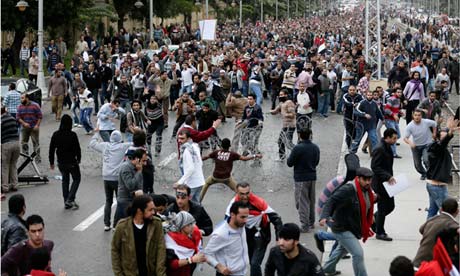
the Palace too, but today, on the second day of the protests, the clashed have
been erupted between the anti-Morsy protesters and the supporters of Morsy and Muslim
Brotherhood who attacked the protesters having their sit-in.
Ministry of Health reports more than 300 injured, there are some reports
about the deaths.
I’d like to share here the BBC report regarding the recent clashes and
the current crisis in Egypt for better understanding of the situation and also
for getting some more details.
The article was originally published here.
Egypt crisis: Clashes in Cairo amid constitution row
Rival protesters have clashed outside the presidential palace in the
Egyptian capital, Cairo, as unrest grows over a controversial draft
constitution.
More than 200 people were injured as protesters threw petrol bombs and
rocks - shots were reportedly fired.
 |
| Clashes erupted during the protests in Cairo |
Violence broke out when supporters of President Mohamed Morsi marched on
his palace, confronting members of the opposition who were holding a sit in.
The government says a referendum on the constitution will go ahead this
month.
Speaking earlier on Wednesday, Vice-President Mahmoud Mekki said the
vote was still scheduled for 15 December, but that the "door for
dialogue" remained open, indicating that changes could be made to the
document later.
Critics say the draft was rushed through parliament without proper
consultation and that it does not do enough to protect political and religious
freedoms and the rights of women.
The draft added to the anger generated by Mr Morsi passing a decree in
late November which granted him wide-ranging new powers.
Four of Mr Morsi's advisers resigned on Wednesday in an apparent
protest. Three others had done so last week.
'Dangerous development'
Supporters of Mr Morsi's Islamist Muslim Brotherhood movement responded
to a call to rally outside the presidential palace, in the suburb of
Heliopolis, on Wednesday afternoon.
The mainly secular opponents of the president were already staging a
sit-in protest there, after tens of thousands of them besieged the palace on
Tuesday.
The pro-Morsi group chanted "The people want to cleanse the
square" and "Morsi has legitimacy", AFP news agency reported.
Stones and petrol bombs were thrown, and Morsi supporters dismantled
some of the tents set up by their opponents.
There were reports of gunfire and witnesses reported seeing a number of
wounded people. There are unconfirmed reports of at least two deaths.
The BBC's Jon Leyne in Cairo says the clashes are possibly the most dangerous
development in Egypt's growing political crisis.
Our correspondent says the violence, which opposition leaders accused
the Brotherhood of organising, was ominously reminiscent of the tactics used by
former President Hosni Mubarak during the revolution.
The Brotherhood later called on all sides to "withdraw at the same
time and pledge not to return there given the symbolism of the palace".
Disorder was also reported in other cities, with Muslim Brotherhood
offices attacked in Ismailia and Suez.
'Must be consensus'
In a joint news conference, Mohamed ElBaradei, Amr Moussa and other
leading figures of the opposition National Rescue Front said they held Mr Morsi
fully responsible for the violence.

"Morsi must listen to the people, whose voice is loud and clear.
There is no legitimacy in excluding the majority of the people," he said.
In his news conference, broadcast earlier on state television, Mr Mekki
said there was "real political will to pass the current period and respond
to the demands of the public".
But he said there "must be consensus" on the constitution, and
that "the door for dialogue is open for those who object to the
draft".
"I am completely confident that if not in the coming hours, in the
next few days we will reach a breakthrough in the crisis and consensus,"
he said.
He proposed that the opposition put their concerns about particular
parts of the constitution into writing, but that this was "not a formal
initiative but a personal idea".
Our correspondent says the government has been speaking for some time
about the need for dialogue, but has offered few concrete concessions which
would end the crisis.
Mr Morsi adopted sweeping new powers in a decree on 22 November, and
stripped the judiciary of any power to challenge his decisions.
Mr Morsi, who narrowly won Egypt's first free presidential election in
June, says he will give up his new powers once the new constitution is
ratified.

No comments:
Post a Comment