 |
| Mohamed Morsy, Egypt's President |
After Egypt’s President Mohamed Morsy has issued on 22 November his
controversial Constitutional Declaration which made his decisions actually
immune from any challenges even by the Court and the draft of the future
Constitution has been put by him on the national referendum scheduled for 15
December the massive protests started in Egypt against such a dictatorial
decisions and unrepresentative Constitution.
President Morsy issued a few statements calling the state’s oppositional
powers and political figures for the negotiations to find the way out of the
current political crisis in the country, but the oppositional forces refused to
take part in any talks until the presidential decree will be cancelled and the
referendum will be cancelled too, as the draft of the Constitution doesn’t
represent all the citizens of Egypt and doesn’t protect the goals of the
Revolution.
The massive protests have been held by anti-Morsy protesters in Cairo’s
Tahrir Square and in front of the Presidential Palace, and also in other
Egyptian governorates. Later the violent clashes erupted when the supporters of
Morsy and Muslim Brotherhood decided to hold their demonstration in the same
place occupied by anti-Morsy protesters. The violence left several deaths and hundreds
of injured, the military and CSF presence is increased, and there are also
fears about the possibility of the escalation of the conflict.
Amid the ongoing demonstrations and clashes Egypt’s President Mohamed
Morsy called for the emergency meeting to discuss the current crisis. All the
political powers of Egypt were invited to participate, according to the
official Presidential spokesperson Yasser Ali.
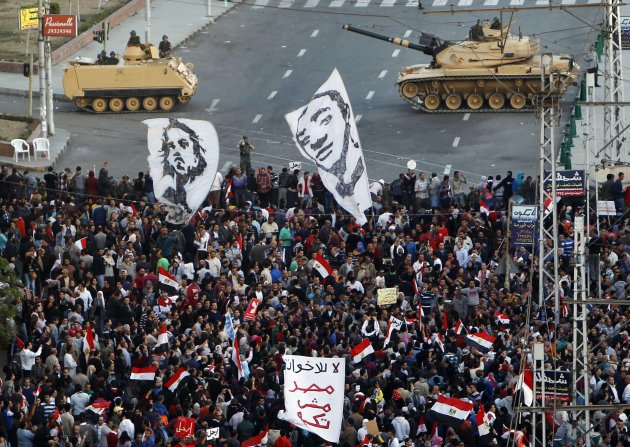 |
| Massive demonstrations in Egypt against the Constitutional Declaration and the draft of the Constitution |
The meeting took place on Saturday, Morsy attended the meeting briefly,
his Vice President Mahmoud Mekki was also presented. Nearly 40 political
figures, representatives of different political powers and intellectuals, have
also attended the meeting.
Among those who have attended the meeting were Al-Azhar Sheikh Ahmed
Al-Tayeb, former presidential candidate with the Islamist background Mohamed
Selim El-Awwa, Ayman Nour, founder of Ghad Al-Tawra Party, Emad El-Din, Abdel-Gafour,
the cairman of Salafist Al-Nour Party, the leaders of moderate Islamists and
several intellectuals and prominent figures.
But the majority of the oppositional forces has ignored the meeting and
didn’t show up. The representatives of the recently established by Mohamed El
Baradei, Hamdeen Sabbahy and Amr Moussa National Salvation Front didn’t attend
the meeting too as they don’t accept either the controversial presidential
decree or the possibility of the referendum on such an undemocratic and
representative Constitution which is considered being established serving the
interests of some political forces and some factions of Egypt’s society only.
After the meeting was held the President declared that the 22 November Constitutional
Declaration will be cancelled in order to fulfill some of the demands of the
protesters, but the national referendum on the constitutional draft will be
held as scheduled, on 15 December. The vote for the Egyptian expats was postponed,
but the referendum should take place. According to the statement of Mohamed
Selim El-Awwa, ex-presidential candidate, who was responsible for revealing the
results of the Saturday’s National Dialog, Mohamed Morsy cannot cancel the
referendum on the Constitution, as it will violate the previous Constitutional
Declaration issued by then-ruling SCAF (Supreme Counsil of the Armed Forces)
which stipulates that the referendum on the Constitution should be held within
15 days after the state’s President will receive the draft of the Constitution
from the Constituent Assembly.
 |
| Egyptians protesting |
The new Constitutional Declaration was issued as a result of the
National Dialog meeting, and this Constitutional Declaration replaces the
controversial 22 November decree. But despite the demands of the opposition
this new decree doesn’t meet a lot of the oppositional demands, such as
cancelling of the referendum, for example.
The new Constitutional Declaration also grants the judicial immunity to
all the Constitutional Declarations and keeps the article regarding the sacking
of Egypt’s Prosecutor General. It also keeps the article about the new
investigations and retrial of the previous regime figures and those responsible
for killing and injuring the peaceful protesters during January 25 Revolution
and the following transitional period (till 30 June 2012), in case the new
evidences will appear.
According to the new Constitutional Declaration issued on 9 December
1012 the previous 22 November presidential decree is void since 9 December, but
all its consequences should remain in effect.
The national referendum on the Constitutional draft would be held as
planned, and if the majority of people will vote for this draft, the work on
the forming of the new authorities I order to achieve stability in the country
will start. If the majority of the citizens will vote against the draft, the
President will call for the direct elections of the new Constituent Assembly
which will be tasked to work on the new draft of the Constitution and should
present the new draft within six months. After the draft will be finalized and
the President will receive it he would set the date for the national referendum
within 30 days after receiving the draft from the Assembly.
The new Constitutional Declaration and all the previous ones remain
immune from any challenges, even by the judicial bodies.
The oppositional forces which didn’t attend the National Dialog meeting
were not optimistic about the new Constitutional Declaration, as it actually
keeps unchanged the main and the most controversial articles of the previous decree
and doesn’t meet all the demands issued by the opposition.
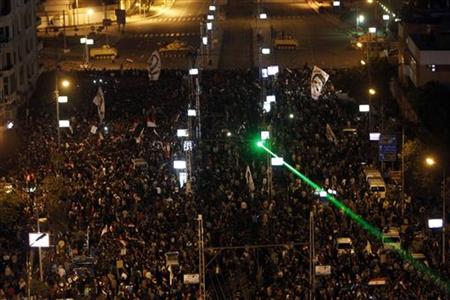
The protests still continue in the country despite the issuing of the
new Constitutional Declaration aimed to calm the protests.

No comments:
Post a Comment